Home Office Shelf Styling: Tidy Shelves Behind the Desk
Zone your office shelving so it works as storage and as a video-call backdrop: styled shelves behind your head, matching boxes and magazine files within reach, and bulky items down low.
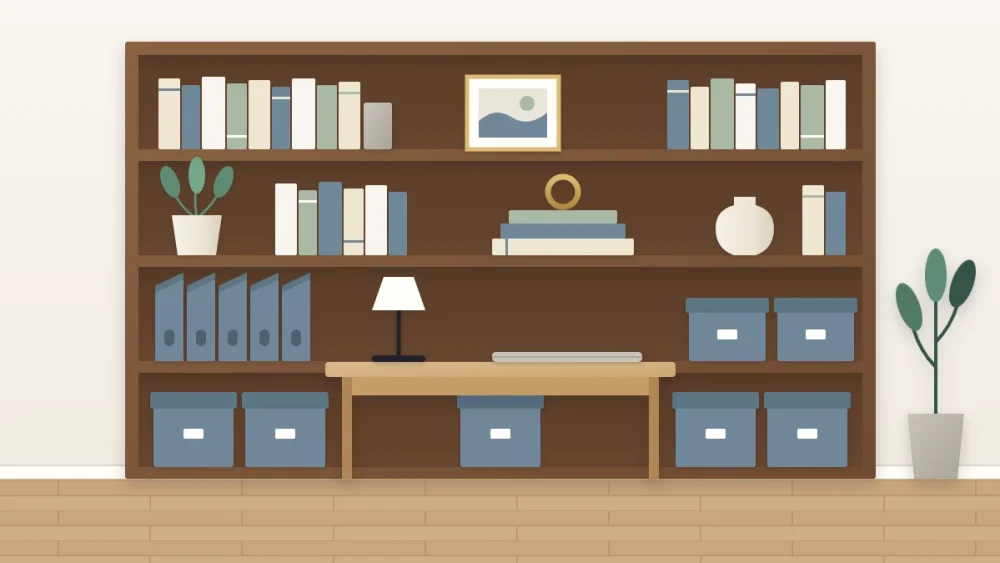
Most home office shelves are asked to do two things that pull in opposite directions. They store the files, paper and supplies you work with, and they sit behind you on every video call, where a wall of clutter is the first thing colleagues notice.
You do not have to pick one. Divide the unit into zones, so that each shelf has a single job, and the same piece of furniture can be working storage and a tidy backdrop at once.
Find out what the camera sees
The backdrop is smaller than you think. Before you move a single box, check exactly which shelves appear on screen.
- Sit at the desk in your normal working position and open your camera preview.
- Note the shelves visible around your head and shoulders. This is usually two shelves, sometimes three.
- Note what is cut off. The lowest shelves are normally hidden by the desk and your chair, and the top shelf is often out of frame.
- Lean back and to each side, the way you do on a long call, and check what comes into view.
Everything in frame is your backdrop zone. Everything out of frame is free to be purely practical.
Give every shelf one job
With the camera view known, sort the unit into three bands. The exact shelves will differ from one room to the next, but the logic holds.
| Zone | Where it is | What goes there | How it should look |
|---|---|---|---|
| Backdrop | Shelves in frame behind your head | Books in neat rows, one plant, a frame, one or two objects | Quiet, simple, part of each shelf left open |
| Working | Shelves within arm’s reach of the chair | Current files, paper, supplies in matching boxes and magazine files | Uniform: one color, one style of container |
| Bulk | Lowest shelves, hidden by the desk | Printer paper, archive boxes, equipment, bags | Tidy but plain, in large closed containers |
If your working zone and backdrop zone overlap, which happens when the unit is directly behind the chair, the working items simply have to be better dressed. Matching containers, covered below, are what make that possible.
Style the shelves behind your head
A backdrop shelf has to read clearly at the size of a thumbnail. Fine detail disappears on camera and small objects turn into visual static, so think in a few large, plain shapes.
- Books in neat rows. Stand them upright with spines aligned near the front edge. A row that fills about two-thirds of the shelf, held by a bookend, looks more deliberate than one stretched edge to edge.
- One plant. A single trailing or upright plant softens the hard lines. Keep the pot in a saucer or cachepot so water stays away from books and paper.
- One frame. A simple print or abstract piece leaning against the back panel works well. The guide to using frames and art on bookshelves covers size and placement.
- One or two objects. A vase, a bowl or a sculptural piece in a matte finish. Shiny surfaces can throw glare back at the lens.
Keep the colors behind your head quiet: neutrals, wood, soft greens and blues, with at most one stronger accent. A busy or brightly colored shelf at head height pulls attention away from your face.
Good to know
Treat the backdrop zone as public. Family photos, mail with your address, certificates showing personal details, calendars and anything else you would not hand to a stranger belong on a shelf the camera cannot see.
Use matching containers as the main styling tool
On the working shelves, the containers are the decor. Twelve different folders, boxes and pen pots look chaotic even when everything is filed correctly. The same contents in one kind of box look calm.
- Choose one color for boxes and magazine files, ideally close to the shelf color or a soft neutral, so they recede.
- Stick to one or two sizes, so the tops line up along the shelf.
- Turn magazine files so the closed spine faces out and the paper is hidden.
- Use lidded boxes for anything loose: cables, chargers, stationery, spare ink.
- Fill the shelf width with a full run of containers where you can. A complete row looks intentional; three boxes and a gap looks unfinished.
Labels are useful, but they add visual noise. Put them inside the lid, on the side of the box that faces you when you pull it out, or on the top edge where only you can read them from the chair. On camera, the front of the row stays blank.
If the working shelves are crowded before you start, clear them first. The pile-sorting pass in the guide to editing a cluttered bookshelf is a quick way to find out how many containers you actually need.
Send the bulky things to the bottom
The lowest shelves are out of frame and awkward to reach, which suits anything large that you use rarely: reams of paper, archive boxes, a shredder, a spare keyboard, the bag you take to the office. Large closed boxes or baskets keep them from looking like a pile.
Placing the biggest, darkest shapes low also helps the unit look balanced, because a shelving unit that is visually heavy at the bottom feels settled. For real weight, stay within what the manufacturer states for each shelf, and spread dense things such as paper across the unit instead of stacking them all on one board.
In a tight office with only one narrow unit, the zones shrink to a shelf each. The layouts in small bookshelf styling show how to keep that from feeling cramped.
Check the screen and adjust
Open the camera preview again and look at the result as a picture, not as shelves.
- Something appears to grow out of your head: slide the plant or tall vase to one side of the frame.
- The backdrop looks cluttered: remove the smallest object from each visible shelf.
- There is glare: swap glass and polished metal for matte ceramic or wood, or angle the frame slightly.
- One side looks empty: move a book stack or the frame across to balance it.
- A working shelf has crept into view: turn its labels inward and straighten the row.
Repeat the check at the time of day you take most calls, since the light changes what shows. Then leave the backdrop alone and let the working shelves take the daily mess.
Frequently asked questions
What should go on the shelves behind me on video calls?
Keep it to a few large, simple shapes: neat rows of books, one plant, one frame and one or two matte objects, with part of each shelf left open. Use quiet colors, and keep personal photos, mail and documents on shelves the camera does not show.
How do I hide office supplies on open shelves?
Put them in matching containers. Boxes and magazine files in a single color and one or two sizes turn mixed supplies into a tidy row. Use lids for loose items such as cables, face the closed side of magazine files outward, and place labels on the inside or the side.
Which shelves should hold the bulky items?
The lowest ones. They are usually hidden by the desk on camera and are less convenient to reach, so they suit paper reams, archive boxes and equipment in large closed containers. Follow the limits the manufacturer gives for each shelf and spread dense items out.