Floating Shelf Styling: Arranging One, Two or Three Wall Shelves
Compose wall shelves like a picture: a tall-medium-low scene on one shelf, staggered groups on two and a zigzag on three, using a few light pieces and open ends.

At a glance
- Difficulty
- Easy
- Time
- About 20 to 40 minutes
- Best for
- Slim wall shelves that look bare, crowded or lopsided
- Shelf type
- Slim wall shelves and floating shelves
What you need
- A few paperbacks or slim hardcovers
- A small frame to lean
- One small vase or bowl
- A trailing plant in a cachepot
- A small bookend
A bookcase is furniture. A slim shelf on the wall behaves more like a picture: it hangs at eye level, it has bare wall all around it, and everything on it is seen as one image. That is the key to floating shelf styling. You are composing a small picture, not filling storage.
It also means less is needed than you might expect. A few light pieces, placed with care and with air around them, will look better than a full row, and they suit what a wall shelf is meant to do.
First, the limits
Styling choices for wall shelves start with safety, so this comes before any arranging.
Before you load a shelf
A wall shelf should be installed following the manufacturer specifications, using suitable hardware for the wall type, and it carries only what the manufacturer states for that shelf. If you do not know how a shelf was installed, or who installed it, keep the display light or ask a qualified installer to check it.
In styling terms, that points to a light hand: a short row or small stack of books in place of a full library, small ceramics in place of large stoneware, and nothing breakable above a bed, a sofa or a spot where people sit.
What belongs on a wall shelf
Pick from a short list and you will rarely go wrong.
- A few books. A flat stack of two or three, or a short upright row closed with a small bookend. Paperbacks and slim hardcovers suit the scale.
- A small leaning frame. It gives height without bulk. The guide to frames and art on shelves has more on sizes and overlapping.
- A trailing plant. Stems that hang below the shelf soften its hard line. Keep the pot in a saucer or cachepot so water never reaches the books; see plants on bookshelves for placement ideas.
- One vessel. A small vase, jug or bowl, chosen for its outline.
Three or four items per shelf is plenty. Leave the last few inches at each end empty so nothing looks ready to slide off, and so the shelf has a margin like a mat around a print.
One shelf: tall, medium, low
A single shelf needs one small scene with a clear high point. A reliable starting point is three heights:
- Place the tall item, such as a slender vase or a leaning frame, about a third of the way in from one end.
- Set the medium item, often a short stack of books, close beside it so the two overlap or nearly touch.
- Leave a clear gap, then place the low item, such as a small bowl, toward the other end.
The outline steps down from tall to low, and the gap keeps it from looking like a lineup. If the shelf hangs above a desk or console, put the tall item on the side opposite any lamp or tall object below, so the two high points do not stack up.
Two shelves: stagger the visually heavy side
With a pair, the shelves are read together. If both carry their biggest group on the left, the whole arrangement appears to lean.
Put the larger, darker or denser group at one end of the upper shelf and at the opposite end of the lower shelf. Fill the lighter end of each with one small item or leave it open. The eye then travels diagonally between the two groups, and the bare wall between them becomes part of the picture.
Repeat one thing across the pair, such as a color, a material or a shape, so they look related: two white ceramics, or brass on both, or books on each.
Three shelves: a zigzag
A stack of three follows the same logic, extended. Place the main group at the left on the top shelf, the right on the middle shelf and the left again on the lowest, or the mirror image of that. The groups trace a zigzag down the wall.
Give each shelf a different lead: books on one, a frame with a small vase on another, the trailing plant on the third. Put the plant where its stems have room to fall, usually an outer end, and never where they will hang across the shelf below.
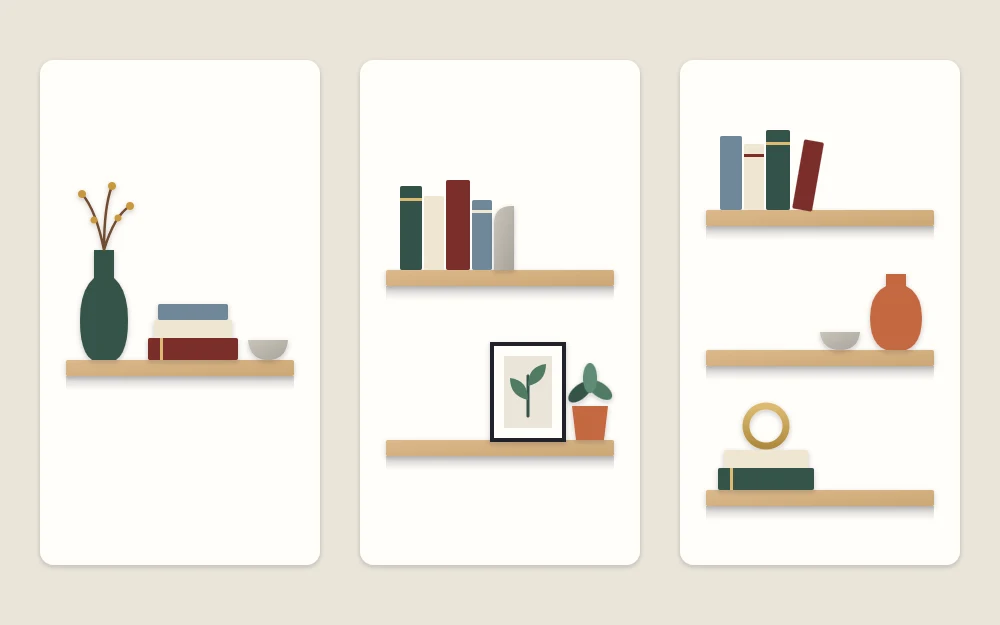
Compositions at a glance
| Shelves | Main idea | A light display |
|---|---|---|
| One | Tall, medium, low with one gap | Slender vase, stack of two books, small bowl |
| Two | Larger groups at opposite ends | Short book row above; leaning frame and vessel below |
| Three | Groups in a zigzag | Books, then frame with vase, then trailing plant |
Common problems and quick fixes
- It looks like a row of ornaments. Heights are too similar and gaps too even. Remove one item, push two together and widen one gap.
- It looks lopsided. A visually heavy group has no answer elsewhere. Move a darker or larger piece to the opposite end of another shelf. The article on visual balance on bookshelves explains how to judge this.
- It looks cluttered. Objects reach the very ends. Clear both ends and take the count down to three per shelf.
- It looks lost on the wall. The pieces are too small to read from across the room. Swap several tiny things for one item with a stronger outline, staying light.
Relating the shelves to what is below
Wall shelves usually hang above something: a desk, a console, a reading chair. Echo one color or material from that piece on the shelves, and keep the area directly above a work surface or seat for the lightest, softest items.
If you find you want more books within reach than a light display allows, a compact freestanding unit is the better home for them. The approach in small bookshelf styling keeps a narrow bookcase looking just as composed.
Frequently asked questions
How many items should go on a floating shelf?
Three or four light pieces per shelf is a comfortable range, with the ends left clear. A wall shelf carries only what its manufacturer states, so choose a short stack or small row of books and small objects, and keep the display light if you are unsure how it was installed.
Can books go on floating shelves?
A few can, as part of a light display: a short upright row with a small bookend or a flat stack of two or three. Stay within what the manufacturer states for the shelf, and keep a larger collection in a freestanding bookcase instead.
How do you style two floating shelves side by side or stacked?
Treat the pair as one picture. Put the larger or darker group at one end of the first shelf and at the opposite end of the second, leave the other ends nearly empty, and repeat one color or material on both so they look related.