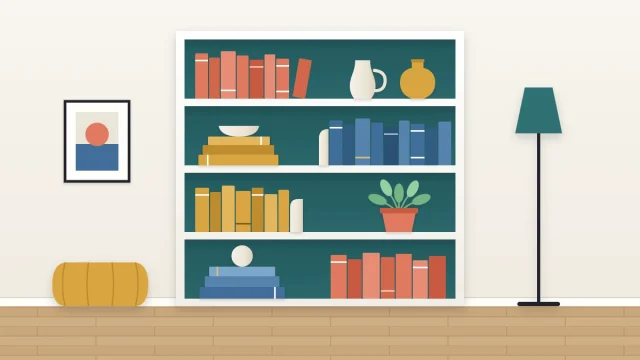
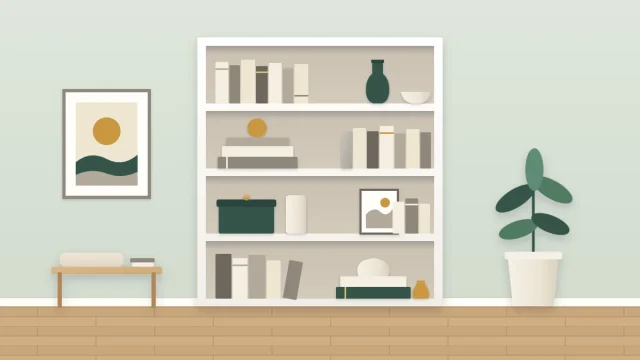
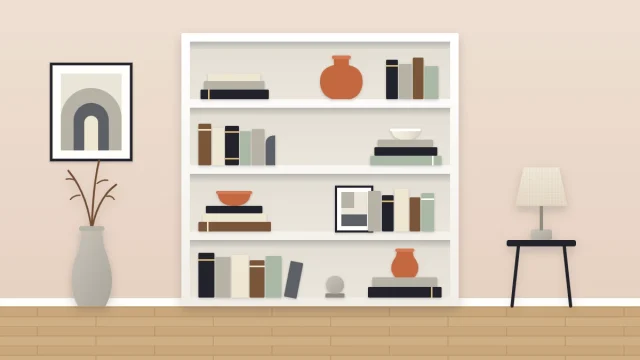
Negative Space on Shelves: Why Empty Room Makes Styling Work
Empty shelf is part of the arrangement, not a gap to fill. See where to leave open space, how much suits your look, and how to keep it from filling up again.

The urge to fill every gap on a shelf is strong. An open stretch of board can look like a job left unfinished, so another frame goes in, then a small bowl, then a few paperbacks laid flat on top of the row. The shelf ends up full and somehow less attractive than it was before.
What went missing is negative space: the empty area around and between things. On a bookshelf it is not leftover room waiting for an object. It is a working part of the arrangement, and deciding where it goes matters as much as choosing the vase.
What empty space actually does
Open shelf does three jobs at once, and none of them can be done by an object.
- It frames. A vase with clear shelf on both sides is read as a chosen piece. The same vase squeezed between a clock and a row of books is read as one more thing.
- It rests the eye. A full unit asks you to look at everything with equal attention. Gaps give the eye somewhere to pause, which is why a shelf with fewer pieces often feels calmer and more finished.
- It shows the shelf itself. The wood grain, the painted back panel, the shadow line under each board are all part of the picture. Cover every inch and you lose the furniture you chose.
Three places to leave it
Empty space is easier to keep when you know where it belongs. On most shelves it sits in three spots.
Above things
Look at the band of air between the top of your objects and the underside of the shelf above. When every book and frame nearly touches the board overhead, the opening looks stuffed even if there are gaps at the sides. Let some pieces stop well short: a low bowl, a flat stack of two or three books, a row of shorter paperbacks. A mix of heights with clear air over the lowest pieces does more than any extra ornament.
Beside groups
A row of books does not have to run from one side to the other. End it early, close it with a bookend or a flat stack, and leave the remaining stretch open or give it to a single object with room around it. The gap beside a group is what turns it into a group.
One opening left almost bare
In a large unit, give one shelf or cubby to a single piece, or to nothing more than a low stack. It acts like a pause in a sentence. Place it away from the dead center of the unit so it looks deliberate, not forgotten.
How much to leave open
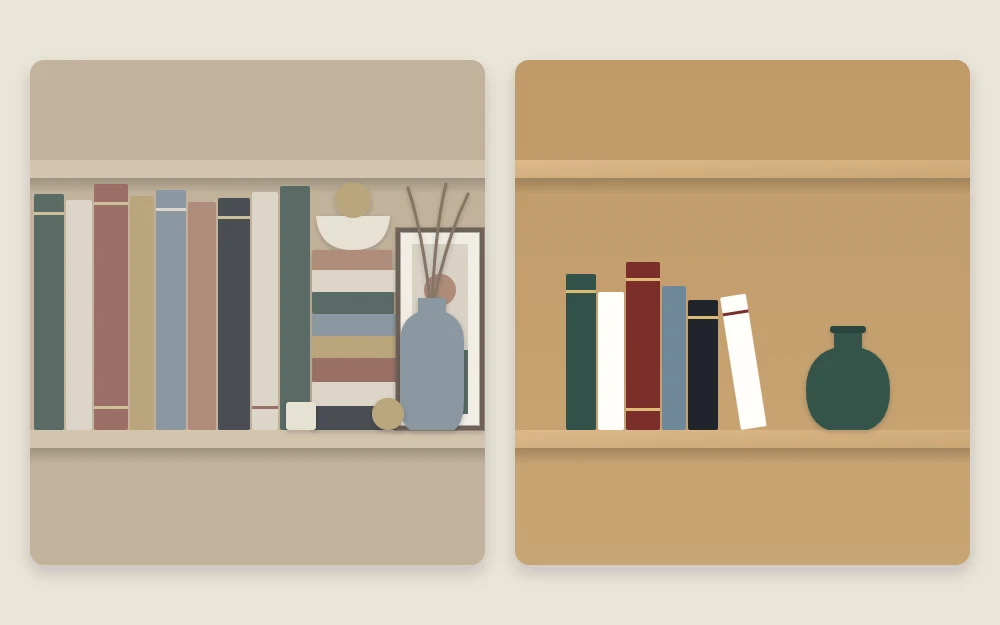
A common starting point is to leave roughly a third of each shelf open, counting the air above low objects as well as the gaps beside them. Treat that as a loose guide, never a rule. The right amount depends on the look you want and on how many books you own.
| Look | Open share of each shelf | How it reads |
|---|---|---|
| Minimal | About half, sometimes more | Gallery-like; each piece is on display |
| Balanced | Roughly a third | Styled but lived in; books and objects share the room |
| Library | A narrow gap and some air above | Book-led and generous, with a few places to breathe |
If the first row appeals to you, the guide to a pared-back, minimal shelf takes it further. If you love a wall of books, the library row is still styling: even one short gap per shelf and a flat stack here and there stop a full bookcase from looking like storage.
Why uneven gaps look better
Equal spacing is the quickest way to make open shelf look awkward. Three objects set the same distance apart read as a lineup, and the eye starts measuring the gaps instead of enjoying the pieces.
Push things together and apart on purpose. Let two objects overlap slightly or nearly touch, then leave a wide stretch before the next thing. Make the gap at one end of a shelf bigger than the gap at the other, and switch sides on the shelf below so the open areas step back and forth down the unit. That stepping is a large part of how a bookcase stays visually balanced without being symmetrical.
Tip
Squint at the unit from across the room. The objects blur into dark shapes and the gaps into pale ones. If the pale shapes are all the same size, or there are hardly any, move something.
Signs a shelf needs more air
- You cannot take one thing off without moving two others.
- Objects stand in front of the book spines along the whole length of a shelf.
- Nothing can be seen of the back panel on any shelf.
- Your favorite piece is on the unit, and visitors never notice it.
- Dusting has become a project.
Two or more of these usually mean the unit needs fewer things, not better ones. Work through a full edit of a cluttered bookshelf before buying anything new.
Keeping the space from filling up again
Open shelf attracts mail, chargers, gifts and the book you just finished. A few habits protect it.
- Give the drift a home. One lidded box or basket on a low shelf takes the small everyday things that would otherwise land in the gaps.
- Trade, do not add. When a new object arrives, something of similar size leaves the shelf. It can go to another room or into a cupboard for a later rotation.
- Leave slack for books. If the collection is growing, keep one lower shelf as a plain, full book shelf with room to expand, so new arrivals do not creep into the display shelves.
- Reset when you dust. Take everything off one shelf, wipe it, and put back only what was meant to be there.
An empty stretch only looks unfinished up close, with an object in your hand. From the sofa, it looks like confidence.
Frequently asked questions
How much of a bookshelf should be left empty?
A loose starting point is about a third of each shelf, including the air above low objects. Go closer to half for a minimal look, or keep just a short gap and a few flat stacks if you want a book-filled, library feel. Adjust by eye from across the room.
Will a shelf with empty space look unfinished?
Up close it can feel that way, but from normal viewing distance open areas make the pieces you kept look chosen. If a gap seems accidental, make it bigger or move it off center. A clearly generous gap looks intentional, while a narrow leftover one looks like something is missing.
What if there are too many books to leave gaps?
Keep some shelves as plain, full book shelves and concentrate the open space on one or two shelves near eye level. On the full shelves, lay a few books flat so there is air above them. That small change in height gives the unit breathing room without removing many books.