Plants on Bookshelves: Styling Greenery Between the Books
Where trailing, upright and small plants look best on a bookcase, how to choose pots that suit the shelves, and what to use when a shelf is too dim for a live plant.
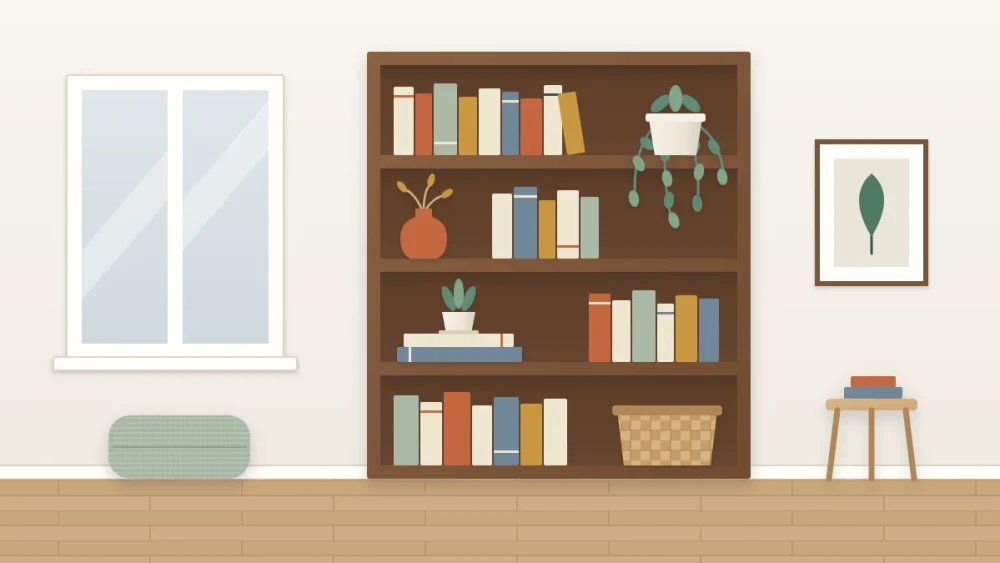
Books, boxes and frames are all hard-edged. A plant is the one thing on a bookcase with an outline you cannot predict, which is why a single pot of green can loosen up a whole unit. Styling plants on bookshelves is mostly a matter of matching the shape of the plant to the shape of the space.
It is also a matter of being honest about light. A shelf is a shaded box, and the prettiest arrangement fails if the plant in it is struggling. Start with shape, then check the light before you commit.
Think of plants as three shapes
For styling purposes you can forget plant names and sort greenery by how it grows. Each habit suits a different part of the bookcase.
| Plant shape | Best position | What it does |
|---|---|---|
| Trailing | An upper shelf, or the open end of a row of books | Draws a loose line downward and links one shelf to the next |
| Upright and compact | A cubby or shelf with clear air above it | Adds a vertical accent, like a vase with texture |
| Small and rounded | On a flat stack of books or beside a low object | Softens a group of hard shapes |
Placing each shape
Trailing plants up high
Set a trailing plant near the front corner of an upper shelf and let the stems fall past the shelf below. Guide them to one side so they hang in front of the upright of the bookcase or an empty stretch of shelf, not across the spines you want to read.
Keep the stems trimmed to a length that overlaps one shelf, perhaps two. A curtain of foliage down the whole unit hides the styling beneath it.
Upright plants with headroom
A compact upright plant needs space above its tallest leaf, or it looks squeezed. As a loose guide, plant and pot together should fill no more than about two-thirds of the opening. Stand it off-center, with a short row of books or a low bowl beside it.
One small plant on a stack
A little pot on three or four flat books is one of the easiest arrangements there is. The stack gives the plant height and a base; the plant gives the stack a soft top. Use this once per unit, and make sure the pot has a saucer under it.
Pots that suit the shelves
On a shelf the pot is at eye level and as visible as the plant, so choose it the way you would choose a vase.
- Match the palette. Pick pot colors already present in your book spines or objects. Plain cream, terracotta, charcoal or a single accent color all work.
- Keep to two finishes. For example matte ceramic and woven fiber, or terracotta and glazed white. More than two starts to look like a garden center bench.
- Scale the pot to the plant. A pot roughly a third of the total height looks balanced. Tiny pots get lost between books.
Good to know
Every pot on a bookcase needs a saucer or a cachepot with no drainage hole, so water never reaches the books or the shelf. Carry the plant to the sink to water it, let it drain fully, then put it back. Damp paper and damp shelf finishes do not recover well.
Light is the honest limit
The inside of a shelf is usually much dimmer than the room around it. The shelf above casts shade, the sides block light from an angle, and a bookcase on the wall opposite a window may receive very little.
Before choosing a spot, look at the unit at midday and notice which shelves are bright. Often it is only the top of the bookcase and the shelves on the window side. Those are your plant positions; let the light decide, and arrange the rest of the styling around it.
- Choose plants sold as tolerant of low or indirect light for shaded shelves, and check the grower’s label.
- Turn the pot every week or two so growth does not lean one way.
- If a plant is stretching, fading or dropping leaves, move it nearer the window and give the shelf to something else.
How the bookcase sits in relation to windows and seating affects more than plants; the guide to living room bookshelf styling looks at the unit as part of the whole room.
When a live plant will not work
Some shelves are simply too dark. That does not rule out greenery as a shape.
- Dried stems and grasses in a vase give height and a soft, feathery outline.
- Bare branches add a strong irregular line and need a shelf with a tall opening or the top of the unit.
- A good artificial plant is a reasonable choice for a dim top shelf. Pick one with matte leaves and varied leaf sizes, and repot it into one of your own containers so it matches the rest.
Mixing one live plant in the brightest spot with dried stems elsewhere often looks better than several live plants struggling. Other non-book pieces that pair well with greenery are covered in what to display besides books.
How many plants per bookcase
One or two per unit is enough. A plant on every shelf turns a bookcase into a plant stand with books in the gaps, and each plant loses its effect.
If you use two, vary them: one trailing and high on one side, one compact and lower on the other, so they sit on a diagonal. On a wide run of display shelves there is room for a third, and the ideas in open shelving styling show how to space them along a longer span.
Tip
Wipe dust from broad leaves when you dust the shelves. A clean, glossy leaf reads as a deliberate part of the arrangement; a dull, dusty one looks forgotten.
A note on pets and children
This guide treats plants purely as decor. Some common houseplants can cause harm if leaves are chewed, so if you share your home with pets or young children, look up each plant with a reliable source before you buy it, and place anything doubtful out of their reach or choose dried stems instead.
Frequently asked questions
Can plants live on a bookshelf?
Some can, on the shelves that receive enough light. Shelf interiors are shaded, so the top of the unit and the side nearest a window are usually the workable spots. Match the plant to the light that position really gets, following the grower's label, and use dried stems where it is too dim.
How do I keep plants from damaging my books?
Give every pot a saucer or stand it inside a cachepot with no drainage hole, and take the plant to the sink for watering so it can drain before it goes back. Leave a small gap between leaves and book spines so damp foliage never rests on paper.
How many plants should I put on a bookcase?
One or two per unit is plenty. Greenery has the most effect as an occasional soft shape among hard edges. If you use two, choose different growth habits and place them on different shelves and opposite sides so they balance each other.