How to Arrange Books on a Shelf: Vertical Rows, Stacks and Mixes
How to sort books, shape upright rows, add flat stacks and mix the two across a bookcase so a large collection looks arranged instead of stored.
At a glance
- Difficulty
- Easy
- Time
- About 45 to 90 minutes, depending on how many books you have
- Best for
- Book-filled shelves that look stored instead of arranged
- Shelf type
- Freestanding bookcases and built-ins
What you need
- Your books
- One or two pairs of bookends
- A basket or open box for paperbacks
- A lidded box or solid pot to end a row
- A soft cloth for dusting
When a home has plenty of books, they are the styling. Vases and frames help, but the look of the bookcase is decided by how the books themselves sit: which direction they face, where each group ends, and what stands next to what.
Knowing how to arrange books on a shelf comes down to three choices made in order. First pick a way of sorting, then shape the upright rows, then add flat stacks to break them up. None of it requires owning different books.
Choose how to sort before you shelve
Sorting decides how the whole unit reads from across the room, so settle it first. The three common options look quite different.
| Sort by | How it looks | Suits |
|---|---|---|
| Subject | Mixed heights and colors, lively and a little uneven | Shelves you pull books from every week |
| Size | Smooth, even lines along the top of each row | A calm, orderly look in a busy room |
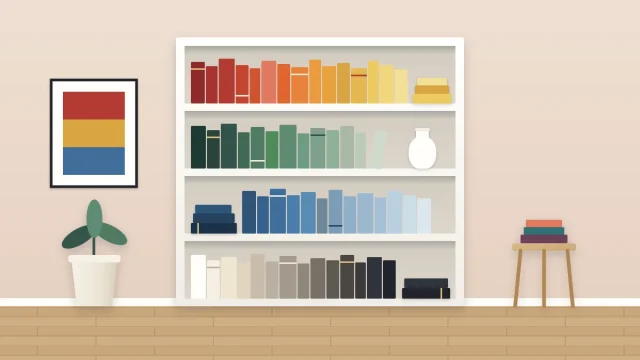
| Color | Bold blocks or a gradual blend of spines | A bookcase that is the feature of the room |
You can combine them. Sorting by subject and then by height within each subject keeps books easy to find and tidies the top line. If color appeals, the guide to organizing books by color walks through blocks, blends and what to do with spines that fit nowhere.
Shape the upright rows
An upright row looks arranged when its top edge has a direction. Two shapes work on almost any shelf:
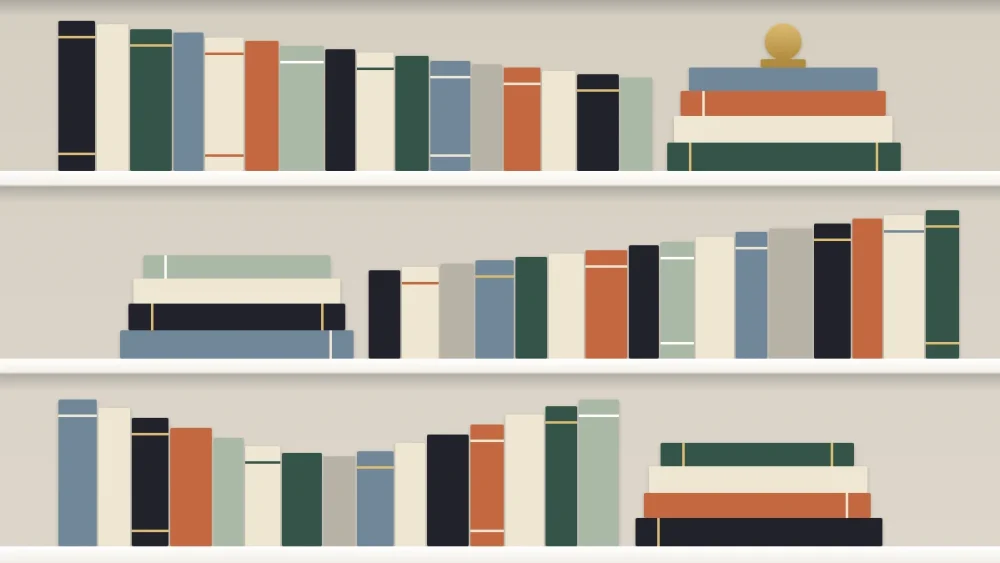
- Sloping to one end. Tallest book at the side of the shelf, stepping down toward the middle. This leaves the open end low, ready for an object or a stack.
- Rising to the center. Shorter books at both ends and the tallest in the middle, or the reverse. This suits a row that fills most of a shelf and stands alone.
Whichever you choose, avoid a jagged skyline where tall and short books alternate at random. It is the main reason a full shelf looks untidy even when it is dusted.
Line the spines up at the front
Books differ in depth, so pushing them all to the back leaves a ragged front. Pull each spine forward until the row is flush, set an inch or so (about 2 to 3 cm) back from the shelf edge as a rough starting point. A straight front catches the light evenly and hides the difference between a slim paperback and a deep hardback.
Give every row an ending
A row that simply stops will lean and slide. Decide what holds the open end:
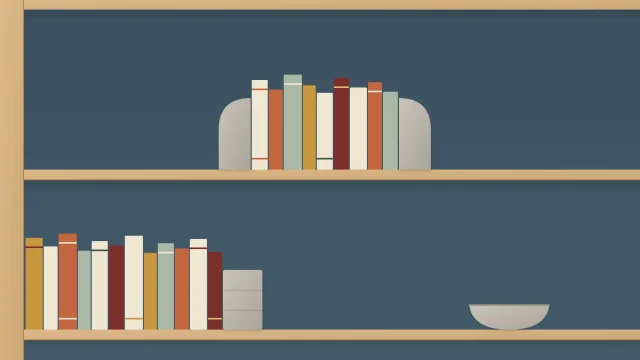
- a bookend, chosen as an object in its own right;
- a flat stack of books pressed against the last upright one;
- a solid object such as a lidded box or a thick-walled pot.
Each gives a different finish, and the article on how to style bookends shows how to match one to the row it holds.
Add flat stacks
A flat stack is the simplest way to interrupt a line of spines. Keep each stack to three to five books, with the largest at the bottom and the smallest on top, so the edges step inward and the stack looks settled. Turn the spines to face the room unless you want a quieter block of page edges.
Stacks are also where the height of a shelf gets used. A stack that reaches about halfway up the opening leaves room for a small object on top. There is more on heights and toppers in the guide to stacking books horizontally.
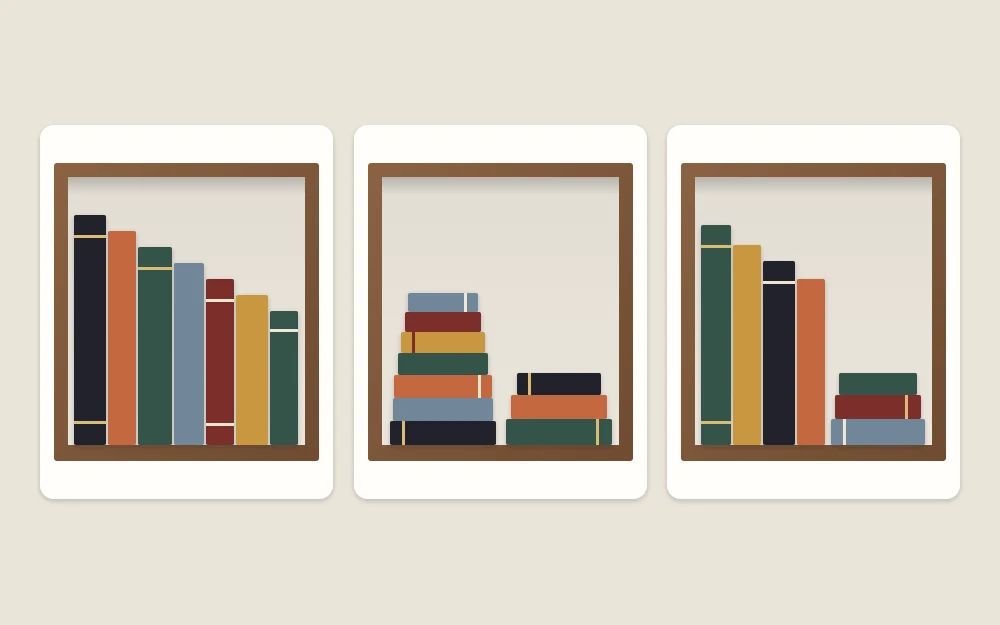
Mix rows and stacks across the unit
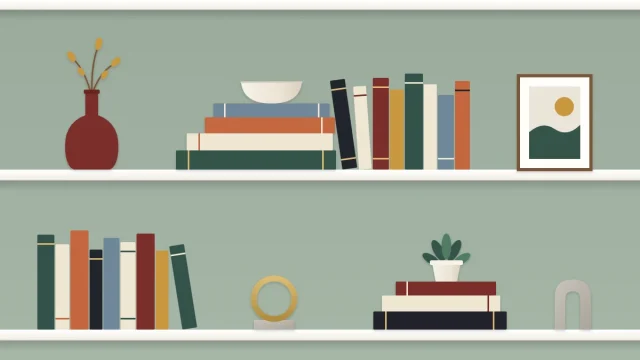
A loose guide for a book-filled bookcase is roughly two upright groups to every flat stack. More stacks than that and the shelves start to look like piles waiting to be sorted; fewer and the unit goes back to looking like storage.
Then alternate the side the stack sits on. Work through the unit like this:
- On the top shelf, place an upright row from the left and end it with a stack on the right.
- On the next shelf, reverse it: stack on the left, row on the right.
- Carry on down, switching sides each time.
- On one or two shelves, skip the stack and use two upright groups with a gap between them.
The alternation stops the stacks lining up in a column, which would split the bookcase in two. Once the books are in, objects can be added following the full method for styling a bookshelf.
What to do with the awkward ones
Paperbacks
Small paperbacks look busy in a long row because their spines are narrow and brightly printed. Group them together on one or two shelves instead of scattering them, or stand them in a basket or an open box with the spines facing up, so they read as a single shape.
Oversized books
Large art and photography books rarely fit upright. Lay them flat as the base of a stack and give them the lower shelves, where the openings are often taller and big, visually heavy shapes look most at home.
Worn spines
Faded or cracked spines can be well-loved without being decorative. Put them in a flat stack turned so the page edges face out, or place them at the far end of a row where an object will stand in front.
Before you load a shelf
Books add up quickly, and a full row of large hardbacks is a real load. Stay within what the manufacturer states for each shelf, and move the surplus to another unit if a shelf begins to bow.
Frequently asked questions
Should books be pushed to the back of the shelf or pulled forward?
Pulling them forward usually looks better. Books vary in depth, so lining the spines up near the front edge gives a straight, even face and hides the difference between slim and deep volumes. Leave a small margin at the front so nothing overhangs the shelf.
How many books should go in a flat stack?
Three to five is a comfortable range. Fewer than three can look like books left lying around, and a tall pile becomes awkward to pull from. Put the largest book at the bottom and the smallest on top so the stack looks stable and steps inward neatly.
Is it better to arrange books by color or by subject?
It depends on how you use them. Sorting by subject makes books easy to find and gives a lively, mixed look. Sorting by color makes a strong visual statement but takes longer to search. Many people sort by subject on working shelves and by color on a display unit.