How to Style Bookends: Holding Rows Upright With Character
How to use bookends as decor: the main types by look, when to use one or a pair, how to judge scale against your books, and everyday objects that can stand in for a bookend.

A row of books that slumps sideways makes the whole shelf look tired. The usual response is to add more books until the row is wedged tight, and that is how shelves end up packed from side to side. Bookends offer a better answer: they let a row stop wherever you want it to.
That makes a bookend a styling tool as much as a support. Chosen with some care, it becomes one of the objects on display instead of a piece of hardware you hope nobody notices.
What a bookend does for the look of a shelf
Visually, a bookend does two things. It gives a row a clean, deliberate finish, like a period at the end of a sentence. And by ending the row early, it frees the remaining shelf for an object or for nothing at all.
That second job matters most. Empty space on a shelf only looks intentional when the things beside it have crisp edges, and a row held firmly upright has exactly that. If you want to understand why the gap is so useful, read about negative space on shelves.
Bookend types, by the look they give
Forget product categories and sort bookends by how much attention they ask for.
Solid blocks
A cube, wedge or arch of stone, wood or metal has a plain outline and plenty of presence. Blocks suit almost any shelf, because they add material and texture without adding a busy shape. Marble or travertine brings pattern; dark wood or black metal brings a strong, quiet accent.
Sculptural shapes
Figures, animals, knots, spheres on a base: these are ornaments that also hold books. Treat one as the main object on its shelf and keep whatever sits near it simple. Two different sculptural bookends on one unit is usually the limit.
Simple L-shaped supports
A thin metal L slides under the last book or two and all but vanishes. Use these when you want the books themselves to be the feature, or when the shelf already has enough going on. Pick a color close to the shelf or the spines.
Stand-ins
Plenty of things can end a row without being a bookend at all:
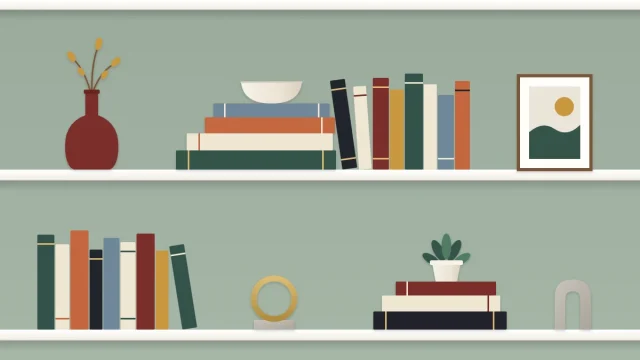
- A flat stack of books. Three or four large books on their sides hold a row well and can carry a small object on top. See how to use horizontal book stacks for sizes and placement.
- A solid, wide-based vase. Choose one with a low center and a flat side for the books to rest against.
- A lidded box. Its straight sides sit flush against the last book, and it hides small clutter as well.
- A potted plant in a stable pot. A broad, weighty pot with a saucer works; a tall, narrow one does not.
Tip
Test any stand-in by pressing the row gently toward it. If the object slides or rocks, shorten the row, stand the books a little straighter, or swap in something with a wider base.
One bookend or a pair?
Both arrangements work, and a unit looks best with some of each.
| Arrangement | How it sits | The effect |
|---|---|---|
| Single bookend | The row starts against the side of the shelf and one bookend finishes it | Informal and efficient; leaves one clear block of open shelf |
| Pair of bookends | A short row stands free in the middle of the shelf, held on both sides | More formal; the books become a centerpiece with space on each side |
| Bookend plus stand-in | A bookend on one side, a stack or box on the other | Relaxed and layered; useful when a matched pair feels stiff |
A free-standing row between a pair looks best when it is short, around five to nine books of similar height. Position it slightly off-center if the shelves above and below are symmetrical, so the unit does not develop a stripe down the middle. The wider question of which rows go where is covered in how to arrange books on a shelf.
Getting the scale right
A bookend should look capable of the job. As a loose guide, aim for a bookend between half and two-thirds the height of the books it holds.
- Too short, and the row seems to loom over it; tall books can also lean across the top.
- Too tall, and the bookend takes over and the books look like an afterthought.
- Too slight, and a long row of large volumes will simply push it along the shelf. Give big books a broad, solid block and keep the row short.
Depth counts as well. A bookend much shallower than the books leaves their front edges unsupported; one that sits near the front of the shelf, in line with the spines, looks neatest.
Before you load a shelf
Stone and metal bookends add real weight to a shelf that is already carrying books. Keep the total within what the manufacturer states for that shelf, and place the most solid pieces on lower shelves where possible.
Repeat the material once
A lone brass bookend on a unit with no other metal can look as if it belongs elsewhere. Repeat its material one more time on a different shelf: a brass frame, a small brass dish, a lamp base. With stone, a pale ceramic vase in a similar tone is enough of an echo.
Once is the right number. Repeating the material on every shelf starts to look like a matching set.
Why a pair does not need to match
Matched pairs are sold together, yet nothing says they must be used together. Two identical bookends on either side of a row give a formal, symmetrical look, which is right for some rooms and stiff in others.
For a looser result, try one of these:
- Split the pair across two shelves, each ending a row that starts at the shelf side, on opposite sides of the unit.
- Pair two bookends that share a material and differ in shape, such as a stone cube and a stone arch.
- Pair two that share a shape and differ in finish, such as the same block in light and dark wood.
What makes a pair read as a pair is one shared quality: material, color or outline. Keep that, vary the rest, and the row will look held with character instead of simply propped up.
Frequently asked questions
Do you need bookends on a bookshelf?
Only where a row stops before the end of the shelf. A row that runs the full width is held by the shelf sides. As soon as you shorten a row to leave open space, something has to finish it, whether that is a bookend, a flat stack or a solid object.
Do bookends have to be used in pairs?
No. A single bookend is all you need when the row begins against the side of the shelf. Pairs are for a short row standing free in the middle. A pair can also be split across two shelves, or mixed with a stack or box on the other side.
What can I use instead of bookends?
A flat stack of three or four large books is the easiest substitute. A lidded box, a wide-based vase or a plant in a broad, stable pot with a saucer can also end a row. Whatever you choose should have a flat side and should not rock when the books rest against it.