Seasonal Bookshelf Decor: A Simple Swap System for the Year
Keep your base styling all year and change only three or four swap spots each season. Ideas for spring, summer, fall and winter, plus how to store the off-season pieces in one small box.

Seasonal bookshelf decor is easy to enjoy and easy to overdo. Restyling every shelf four times a year means boxes of themed objects, an afternoon of work each time, and a bookcase that never quite settles.
A swap system is lighter. The books and main objects stay where they are all year, and only three or four chosen spots change with the season. Each changeover takes a few minutes, and everything you are not using fits in one small box.
Set a base that works all year
The system depends on a base styling you are happy to look at in any month. That means the book rows, flat stacks, bookends, frames and larger objects in a calm palette that does not belong to one season: neutrals, wood, a soft green or blue, perhaps one deeper tone.
If your shelves currently mix many strong colors, settle that first. A seasonal accent only shows when the background is steady, and the guide to choosing a bookshelf color palette walks through picking those base shades. Once the base is right, leave it alone.
Choose three or four swap spots
A swap spot is a position on the unit where one thing changes and nothing around it has to move. Four types work on almost any bookcase:
- One vase. The vase can stay; what goes in it changes. This is the hardest-working spot in the system.
- One book stack topper. The small object sitting on a flat stack of books: a shell, a pine cone, a little dish.
- One frame insert. Keep the frame and slip a different print, pressed leaf or piece of colored paper behind the glass.
- One bowl. A wide, shallow bowl that holds a handful of something seasonal.
Spread the spots across the unit instead of clustering them: one high on the left, one in the middle, one lower on the right. A loose zigzag carries the seasonal color across the whole bookcase, so three small changes read as a full refresh. On a small unit, two spots are enough.
The shape and size of the containers matter more than what fills them. For help choosing a vase and bowl that suit your shelf height, see the guide to styling vases and bowls on shelves.
What to swap in each season
Treat each season as one accent color and one or two natural materials laid over the base. These are starting points, not a set list.
| Season | Accent tones | Vase and bowl | Topper or frame |
|---|---|---|---|
| Spring | Pale green, soft white | Budding or leafy branches; speckled egg shapes in the bowl | A simple leaf print |
| Summer | Light blue, sand, clear glass | A clear glass vase with one or two stems; shells in the bowl | A large shell or piece of sea glass |
| Fall | Rust, ochre, brown | Dried grasses and seed heads; small gourds or acorns in the bowl | A pressed leaf in the frame |
| Winter | Cream, deep green, a little metal | Evergreen sprigs; pine cones or a few plain ornaments in the bowl | A small brass or silver-toned object |
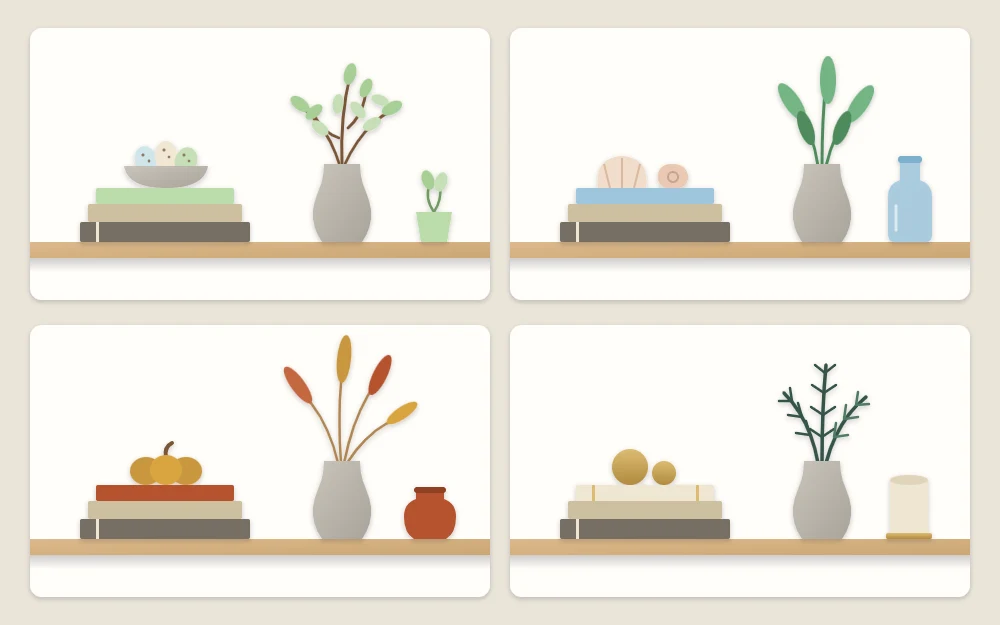
Notice how little changes from one tile to the next. The shelf, the stack and the vase are constant, which is why the result looks composed instead of themed. The colder months have more options, including light and texture, and the guide to fall and winter bookshelf styling covers them in depth.
Use book spines as a seasonal accent
Your books are a free source of seasonal color. You do not need to rearrange the shelves; one stack is enough.
- Swap a single stack. Pull three or four books in the season’s accent color from elsewhere in the unit and lay them flat in a visible spot. Rust and brown spines for fall, pale blue or green for the warmer months.
- Turn a stack. If the spines on a flat stack clash with the season, turn the stack so the page edges face out. Cream paper edges suit every season, winter especially.
- Change the top book. Often only the top cover of a flat stack is seen from above, so swapping that one book is enough.
Put the books back in their usual places when the season ends, so you can still find them.
Reach for natural materials first
Branches, grasses, seed heads, shells, cones and stones are what make a seasonal shelf feel like the season outside instead of a store display. They also age well: nothing about a bowl of pine cones looks dated next year.
A few practical points keep them tidy on a bookcase:
- Shake dried grasses and seed heads outdoors before bringing them in, since they shed.
- Fresh branches need water, so use a vase that sits steady and stand it well clear of book spines. Wipe up drips right away.
- Keep stems in scale: as a loose guide, the arrangement should clear the shelf above with room to spare, not press against it.
- One material per container looks calmer than a mix.
Candlelight on a shelf means flameless LED candles
If you like the look of candlelight in fall and winter, use flameless LED candles on a bookshelf. A shelf is an enclosed space full of paper, with another shelf directly above, so an open flame has no place there. A battery candle with a warm, steady glow gives the same soft effect and can sit safely beside books.
Two or three flameless LED candles of different heights, grouped on one shelf, look better than single ones dotted around. They can count as one of your swap spots.
Keep the off-season pieces in one small box
The size of the box is the discipline of the whole system. Choose one container, about the size of a shoebox, and let it set the limit.
- Give each season a paper envelope or small bag inside the box for its frame insert and small toppers.
- Wrap anything breakable and lay the dried stems on top.
- On changeover day, take out the outgoing pieces, put in the new ones, and return the borrowed books.
- If something new will not fit, something old leaves the box.
Store the box on the bottom shelf of the same bookcase if you can. When the swap takes five minutes and the supplies are within reach, you will actually do it four times a year.
Frequently asked questions
How many things should I change on a bookshelf each season?
Three or four is plenty for a full-size bookcase, and two for a small one. Pick fixed swap spots, such as one vase, one bowl, one frame insert and the object on top of a book stack, and spread them across the unit so the seasonal color travels over the whole piece.
Can I use candles on a bookshelf for a cozy seasonal look?
Use flameless LED candles only. A bookshelf is an enclosed space full of paper with another shelf directly overhead, which is no place for an open flame. Battery candles with a warm glow give a similar effect, and a small group of two or three in different heights looks best.
Where do I keep seasonal shelf decor when it is not in use?
In one small box, roughly shoebox size, with an envelope or bag inside for each season. The limit keeps the collection from growing: when something new will not fit, something old leaves. Storing the box on the bottom shelf of the same bookcase keeps each changeover quick.