Styling Vases and Bowls on a Bookshelf
How to group and place vases and bowls on a bookshelf: sort them by shape, vary the heights, leave most empty, raise bowls on book stacks and keep finishes in one color family.
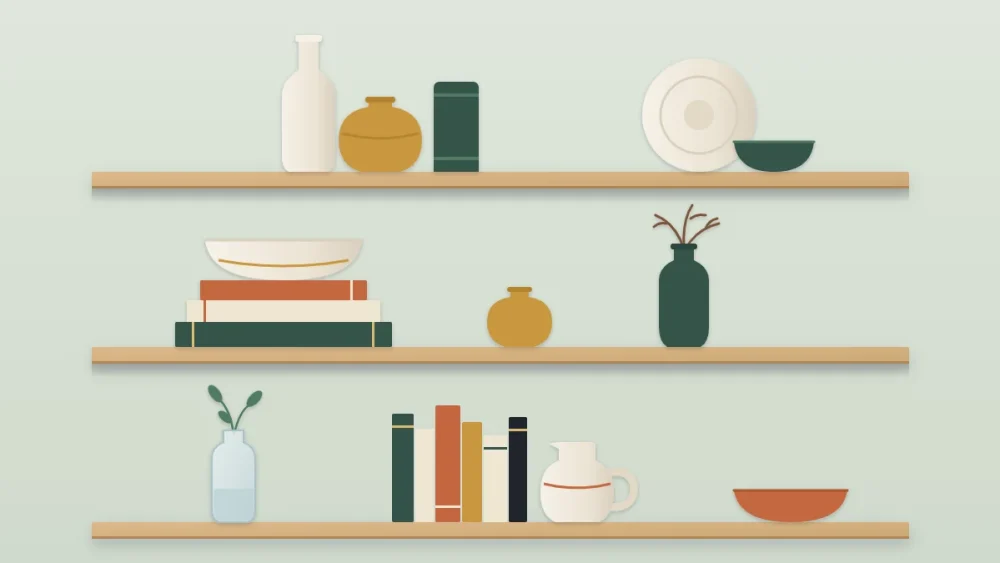
Books give a shelf straight lines and right angles. Vases and bowls give it curves, and that is their real job on a bookcase. Before you think about color or what goes inside them, look at each vessel as a silhouette: tall, round, wide, pinched, handled.
A few vases and bowls placed with that in mind will do more for a unit than a crowd of smaller ornaments. What follows is a way to sort the ones you own, group them and find each a spot.
Read each vessel as a shape
Gather every vase, jug and bowl you might use and stand them together on a table. Ignore pattern for a moment and sort them by outline. You are looking for variety, because three pieces with the same profile repeat one note three times.
| Shape | What it adds | Good spot |
|---|---|---|
| Tall and narrow vase | A vertical accent, the high point of a shelf | Beside a low stack or at the end of a short row |
| Round, low vase | A soft, full curve against straight spines | In front of a leaning frame or next to upright books |
| Jug with a handle | An irregular outline and a hint of everyday use | Alone, with the handle turned to the side |
| Wide bowl | A low horizontal line | On a flat stack of books or a lower shelf |
If everything you own falls into one row of that table, borrow a contrasting shape from another room before buying anything new.
Grouping vases
Odd numbers, different heights
A group of three is the usual starting point: one tall, one medium, one low. Stand them close enough that their outlines overlap slightly when seen from the front, with the tallest toward the back and to one side instead of in the center. The group should read as one shape with a stepped top edge.
Or one strong single
A large vase with a confident outline does not need companions. Give it a third of a shelf to itself and leave the space around it empty. One strong single and one group of three on the same unit is a better mix than several groups.
Check the height against the opening
Hold each vase in the shelf opening before you commit. There should be visible air between the rim and the shelf above; as a loose guide, a vase that fills about two-thirds of the height looks comfortable. A piece that nearly touches the shelf above looks jammed in, however handsome it is.
Empty, or with stems?
Most vases on a bookcase look best empty. The shape is the point, and filling each one turns the shelves into a row of small arrangements competing for attention.
Choose one vase per unit to hold something, and keep it simple: a single bare branch, a few dried stems or grasses. The stems add a loose, irregular line that nothing else on the shelf can supply. They need headroom, so use a shelf with a taller opening or the top of the unit, and trim the stems until they clear the shelf above.
Where bowls work
A bowl is easy to lose on a shelf because, from the front, you mostly see its side. Three placements solve that.
- On a book stack. Raised on three or four flat books, a bowl gains height and a clear base. Choose one a little narrower than the top book.
- On a low shelf. Below eye level you look down into a bowl, so the inside becomes part of the display. This is the place for a bowl with a glazed or patterned interior.
- As a catchall, kept nearly empty. A bowl that collects keys, coins and cables stops being decor. Allow it one or two things, or nothing.
A shallow dish or plate can also stand upright at the back of a shelf, leaning on the back panel, as a round backdrop for a smaller object in front. That is a layering move, and building depth from back to front explains how to stage it.
Tip
Turn every vessel a little before you settle on its position. A jug looks different with the handle to the left, to the right or hidden, and a hand-thrown bowl often has one side that is clearly its best.
Finish and color
Shape comes first, and surface comes second. A few choices keep a mixed set of vessels looking related:
- Mix matte and glazed. A chalky, unglazed vase beside a glossy one gives contrast without adding a color. All matte can look flat; all gloss can look slippery.
- Stay in one color family. Cream, sand and ochre, or several greens from pale to deep, will sit together even when the shapes differ a lot. Add one deeper tone as an accent and repeat it on another shelf. The guide to choosing a bookshelf color palette shows how to pick that family from what you already have.
- Put glass near light. Clear or tinted glass disappears against a dark back panel. Place it on the shelf that catches the most daylight, where it can glow instead of vanishing.
Spreading vessels across the unit
Once the groups are made, stand back and look at where the curves fall. Vessels should be scattered through the unit, not gathered on one shelf: a group on an upper shelf to one side, a single on a middle shelf to the other, a bowl lower down.
Vases and bowls are only one kind of object, and a bookcase styled with nothing else can start to resemble a pottery display. Break them up with a frame, a box or a plant, drawing on the wider list of decor objects for bookshelves.
Keeping fragile pieces safe
Ceramic and glass do not forgive a fall, so placement is partly practical.
Good to know
Set breakable pieces well back from the front edge, never overhanging it. In a home with children, pets or a lot of traffic past the bookcase, keep fragile vessels off the highest shelves, where a knock sends them furthest, and off the lowest ones within easy reach.
Give tall, narrow vases particular care, since they tip most easily. Stand them where books or the side of the unit are close by, and avoid putting them next to the books you pull out every day.
Frequently asked questions
Should vases on a bookshelf have flowers in them?
Most can stay empty. On a bookcase a vase is there for its outline, and filling every one makes the shelves look busy. Choose a single vase per unit to hold a bare branch or a few dried stems, and make sure they clear the shelf above.
How many vases should be grouped together on a shelf?
Three is a comfortable starting point, in different heights so the group has a stepped top edge. One large vase alone can be just as effective. Pairs of identical vases tend to look stiff, so if you own two the same, try them on separate shelves.
Where should a decorative bowl go on a bookshelf?
Either raised on a flat stack of books, where it gains height, or on a shelf below eye level, where you can see inside it. Avoid high shelves, since a bowl seen only from underneath shows very little of its shape.