How to Style a Large Bookshelf Without It Looking Busy
Plan a wall-wide or floor-to-ceiling unit as one composition: three bands, five passes, a short list of repeated materials and objects larger than feels natural.
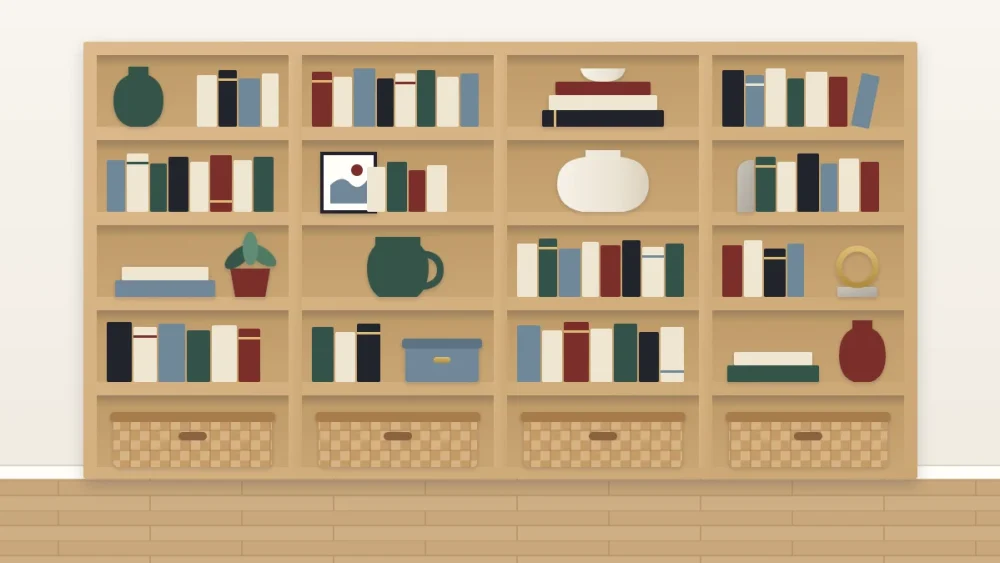
Twenty openings sounds like a luxury until you stand in front of them with a box of vases. Style each shelf on its own, one after another, and you end up with twenty small arrangements that have nothing to say to each other. That is what “busy” means on a large bookshelf: plenty of nice moments and no overall idea.
The way out is to reverse the order. Decide what the whole wall is doing first, and only then go near an individual shelf. The method here works in passes across the entire unit, from the biggest decisions to the smallest.
Start from across the room
Stand as far back as the room allows and look at the unit as one shape. Notice what is around it: a window on one side, a doorway, a sofa in front of the lower rows. Those tell you which parts will be seen most and which are half hidden.
Then clear the display pieces off, leaving the books for now, and gather every object on the floor or a table. Seeing everything at once shows you what you have a lot of, and it usually reveals that a large unit needs fewer, bigger things than it had.
Divide the unit into three bands
Before placing anything, give each horizontal band a job. This single decision removes most of the overwhelm.
| Band | Job | What goes there |
|---|---|---|
| Low rows | Practical and grounded | Matching baskets, closed boxes, oversized books, full rows |
| Eye-level rows | Display | Your best objects, mixed stacks and rows, the most open space |
| Top rows | Light and simple | Books, a few large light pieces such as baskets, little else |
A run of matching baskets along the lowest row is one of the most effective moves on a wide unit. It draws a steady line under everything above it.
Work in passes, not shelf by shelf
Each pass covers the whole unit before the next begins. Step back after every one.
- Books. Decide which openings will be books only and fill them. Aim for a good share of the unit, perhaps a third to a half, as a loose guide. In the remaining openings, place shorter runs and a few flat stacks, switching between left and right as you go.
- The largest objects. Pick your five or six biggest pieces: tall vases, wide bowls, large baskets, a sizable framed print. Place them in a zigzag, moving from side to side as you go down the unit, so no two sit directly above or beside each other.
- Medium pieces. Add the next size down, each one close to a book group or a large piece so it forms a cluster instead of standing alone.
- Small things, sparingly. Only now place small objects, and only on top of flat stacks or grouped on a tray at eye level.
- Remove. Take away about one piece in five. Whatever you do not miss stays off.
The zigzag in the second pass is what keeps a big unit from tilting to one side. The reasoning behind it, and how to check it, is covered in the guide to bookshelf visual balance.
Tip
Mark the spots for your largest pieces with sheets of paper before lifting anything. Moving paper around twenty openings is much quicker than moving stoneware.
Repeat a small set of materials and colors
Variety is what turns a large unit busy. With so many openings, it is tempting to give each one something different. Do the opposite: choose a short list and repeat it everywhere.
- Two or three materials, such as pale ceramic, woven fiber and one metal.
- One or two accent colors on top of your neutrals.
- One or two repeated shapes, such as round vases or rectangular boxes.
When the same ceramic white turns up eight times across the wall, twenty shelves read as one idea. Anything outside the list can live elsewhere in the house.
Choose objects bigger than feels natural
Scale changes with distance. A vase that looks generous in your hands shrinks to a dot on a wall-wide unit seen from the sofa. As a loose guide, a main object should fill about two-thirds of the height of its opening.
If you do not own large pieces, fake the scale with grouping: three similar vases set close together, a stack of big books with a bowl on top, or a basket holding a folded throw. One group counts as one large object.
Build in places for the eye to rest
Give one or two openings to a single item
On a big unit, an opening with one object in it, and nothing else, is not wasted. It is the pause that lets the fuller openings make sense. Pick one or two spots in the display band, off center and apart from each other, and give each a single strong piece.
Where to put that kind of breathing room on the remaining shelves, and how much, is explained in the article on negative space on shelves.
Let some shelves be only books
A wall-wide unit that is styled in every opening looks like a shop. Plain rows of books are the calm background that the display needs, and they are the reason the furniture exists.
Scatter the books-only openings through the unit instead of gathering them in one block, and keep the spines level with the front edge. On these shelves, a full row from side to side is fine.
Take care with the top rows
High shelves are seen from below and reached rarely, so keep them simple.
Before you load a shelf
Use a stable step stool for high shelves, never a chair or the unit itself. Keep heavy-looking or breakable pieces off the top rows; books and light baskets suit them better. Stay within what the manufacturer states for each shelf.
Objects up there should have a clear outline, since detail is lost at that height. One piece per opening is plenty.
Check the whole wall again
Go back to where you first stood. Squint. You should see a steady low band, a livelier middle and a quiet top, with the large pieces stepping from side to side. If one area looks crowded, remove something there before adding anything elsewhere.
If your unit is fitted wall to wall with fixed dividers or cabinets below, the same passes apply, with a few extra considerations set out in the guide to styling built-in bookshelves.
Frequently asked questions
Where do you start when styling a large bookshelf?
Start from across the room, not at a shelf. Decide which rows are practical, which are for display and which stay light, then place books, followed by your five or six largest objects in a zigzag. Smaller pieces come last, and some come off again.
How many objects does a large bookcase need?
Fewer than its size suggests. A handful of large pieces, a modest number of medium ones and very few small items is usually enough, with plain rows of books in many openings. If the unit looks busy, remove pieces before rearranging them.
What should go on the top shelves of a tall unit?
Keep the top rows simple: books and a few light pieces with a clear outline, such as baskets. Leave breakable or heavy-looking objects lower down, use a stable step stool to reach, and stay within what the manufacturer states for each shelf.