Bookshelf Styling Mistakes: 10 Common Problems and Simple Fixes
Ten common reasons a bookshelf looks off, from shelves packed edge to edge to visually heavy pieces at the top, each with the cause and a quick fix you can make today.
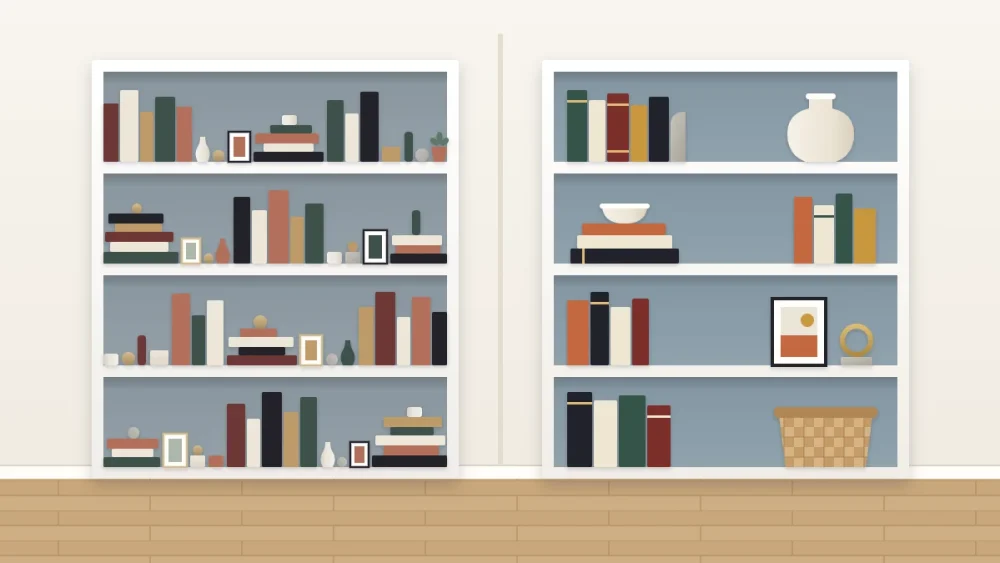
Shelves that look wrong are rarely short of nice things. More often one or two habits are being repeated on every shelf, and once you can name the habit, the correction takes minutes. The most common bookshelf styling mistakes are about spacing, scale and placement, not about what you own.
Stand across the room, look at the whole unit, and read through the ten problems below. Each one comes with the reason it happens and a quick fix. Correct the two or three that apply to your shelves and leave the rest alone.
Too much on the shelf
1. Every shelf filled edge to edge
Why it happens: an empty stretch of shelf feels unfinished, so it gets filled. The result is a solid wall of stuff with nowhere for the eye to pause.
The fix: clear roughly a third of each shelf and let it stay empty. A gap beside a row of books is what makes the row look deliberate. The guide to using negative space on shelves explains where those gaps do the most good.
2. Too many small objects
Why it happens: small things are easy to buy and easy to keep. From across the room, though, a dozen little pieces blur into visual noise.
The fix: swap several small items for one larger one. A single generous bowl or vase does more than five trinkets. Group the small pieces you love on a tray or in one cubby so they read as a collection, and store the rest. If you are unsure what to take away first, follow the order in how to edit a cluttered bookshelf.
No change in height or depth
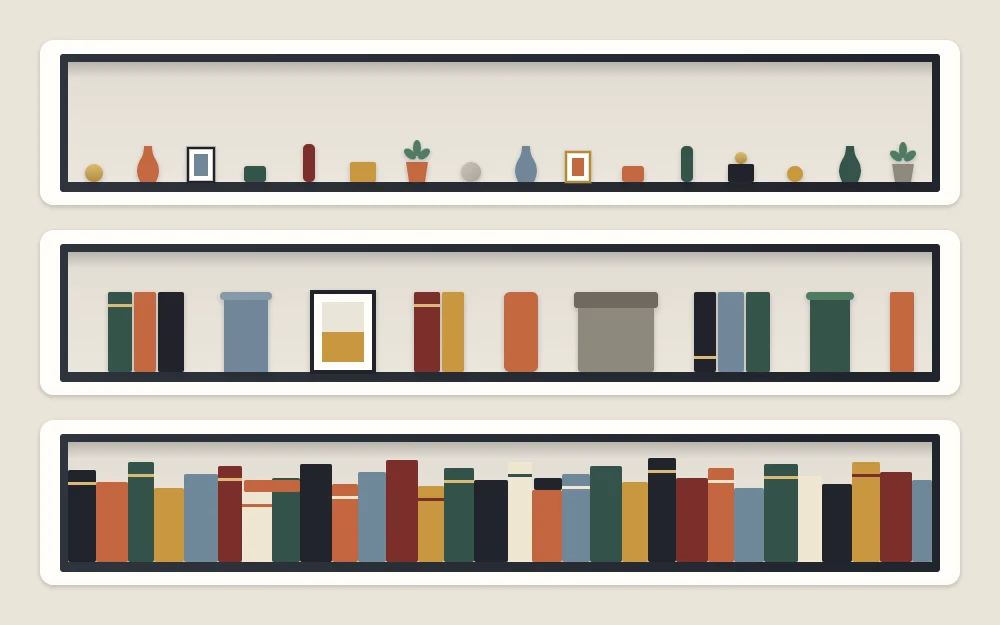
3. Everything the same height
Why it happens: books of a similar size are shelved together and the objects beside them happen to match. The top edge of the shelf contents becomes one flat line.
The fix: give each shelf a high point, a middle and a low point. A tall vase, a row of books and a low bowl is enough. Lay a few books flat to make a step down, or stand one object on a stack to make a step up.
4. Objects lined up along the back
Why it happens: pushing things back feels tidy. It also turns the shelf into a lineup, with each piece side by side and all the depth unused.
The fix: pull one item forward and let it overlap the thing behind it. A frame at the back, a vase slightly in front and to one side, and a small object nearest the edge creates depth from the same three pieces.
Books treated as filler
5. Every book upright with no break
Why it happens: upright is how books are stored, so the whole unit ends up as unbroken vertical stripes.
The fix: shorten some rows so they stop before the end of the shelf, and turn a handful of books into flat stacks of three to five. Alternating upright rows and stacks gives the unit rhythm. For the full set of options, see how to arrange books on a shelf.
Color and balance that work against you
6. Decor scattered with no repeated color
Why it happens: objects are collected one at a time, each chosen for itself. Together they share nothing, and the shelves look restless.
The fix: pick one accent color you already own several times and place it in at least three spots across the unit, on different shelves. Move pieces that fight with it to another room. Repetition is what makes separate shelves look like one arrangement.
7. Heavy-looking pieces at the top
Why it happens: the top shelf is out of reach, so large dark boxes and oversized items get parked there. The unit then looks as if it is about to tip forward visually, even when it is perfectly stable.
The fix: move the darkest, largest and most solid pieces to the lower shelves and keep the upper shelves lighter in color and more open. The article on visual balance on a bookshelf shows how to spread the remaining pieces in a zigzag.
Before you load a shelf
Restyling often means moving books and large objects from one shelf to another. Whatever ends up where, keep each shelf within the limit its manufacturer states, and if a shelf is bowing, take things off it.
8. Matching pairs everywhere
Why it happens: symmetry feels safe, so there are two identical vases here and two identical frames there. Repeated on every shelf, pairs look stiff and a little like a shop display.
The fix: keep one pair at most and split the others. Put one of each on different shelves, or group three related pieces of different heights instead of two the same.
Parts of the unit that get overlooked
9. Ignoring the lowest shelf
Why it happens: the bottom shelf sits below eye level, so it becomes the place for whatever is left over.
The fix: treat it as the base of the whole composition. Fill it more fully than the shelves above with your largest books, laid flat or standing, or with a pair of matching baskets. A calm, solid bottom shelf makes everything above look steadier.
10. Styling up close and never stepping back
Why it happens: you arrange with your hands on the shelf, one shelf at a time. Each shelf looks fine alone, yet the unit as a whole is lopsided.
The fix: after every few changes, walk to the far side of the room and look at the entire unit. Squint so the details blur. Dark patches, crowded corners and bare spots show up at once.
Which fix to make first
If several of these apply, work in this order so you are not rearranging the same shelf twice:
- Take away: clear space and remove surplus small objects.
- Rework the books into shorter rows and a few stacks.
- Move the visually heavy pieces down and style the lowest shelf.
- Vary heights and pull one piece forward on each shelf.
- Repeat your accent color, break up the pairs, then step back and adjust.
Tip
Take a picture of the unit on your phone before and after. A small flat image makes imbalance much easier to spot than standing in front of the real thing.
Frequently asked questions
Why does a bookshelf look cluttered even when it is tidy?
Tidy and calm are different things. A shelf can be neat and still look busy if it is filled from side to side, holds many small objects, or has no repeated color. Clear some space on each shelf, trade several little pieces for one larger one, and repeat a single accent color across the unit.
How many decorative objects should go on one shelf?
There is no fixed number, but one to three objects per shelf alongside the books is a comfortable starting point. Larger pieces need fewer companions. If you can no longer see a clear gap of empty shelf, or the objects blur together from across the room, take one away.
Should the bottom shelf be styled differently from the others?
Yes. The lowest shelf works best as a visual base, so it can be fuller and darker than the shelves above. Large books, baskets or boxes suit it well. Keep within what the manufacturer states for the shelf, and save delicate, detailed pieces for the shelves nearer eye level.