Displaying Collectibles on a Bookshelf Without the Clutter
Eight display ideas that help a collection look curated instead of crowded: group it, give it a shelf of its own, order it by size or color, raise the back row and leave room around the best piece.
A collection is the most personal thing a bookcase can hold, and also the easiest to get wrong. Twenty small figures spread across six shelves look like twenty things nobody put away. The same twenty, gathered and arranged, look like something you chose.
The eight ideas below are about displaying collectibles so they read as one considered feature: pottery, cameras, toy cars, shells, figurines, records, whatever you have gathered. None of them needs special equipment, and you can use two or three of them together on the same shelf.
1. Keep the collection together
The instinct is to share a collection around, one piece per shelf, so every shelf gets something interesting. It has the opposite effect. Scattered pieces lose their connection to each other and start competing with everything nearby.
Bring every piece to one area instead. A group of similar objects is read as a single shape, which is far calmer than the same objects dotted about. It also tells a visitor at a glance that this is a collection and not a series of accidents.
2. Give it a shelf or cubby of its own
Once the pieces are together, give them a clear boundary. One whole shelf, or one cubby in a cube bookcase, becomes the collection’s frame. Nothing else lives there: no paperbacks squeezed in at the end, no spare frame.
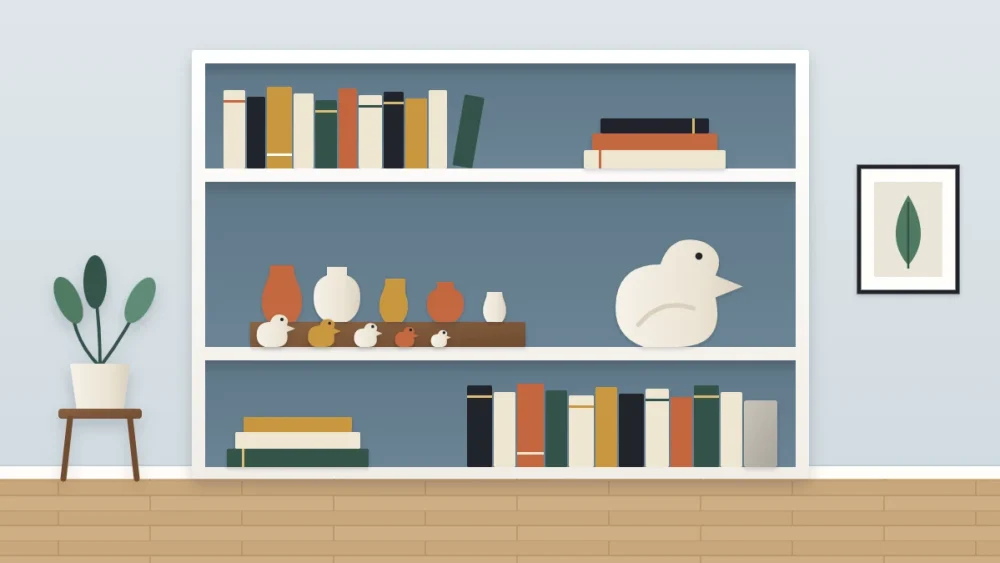
In a unit that also holds books, the neatest layout is a sandwich: a shelf of books above, the collection shelf in the middle around eye level, and a shelf of books below. The plain rows of spines act as a quiet border, and the collection gets the best position in the unit.
3. Arrange by size or by color
A collection needs one ordering idea, and the two simplest are size and color. Pick one and apply it to the whole group.
- By size: tallest pieces at the back and toward one end, stepping down to the smallest at the front. A gentle slope looks more natural than a strict staircase.
- By color: group the blues, the creams, the browns. This suits collections where the shapes are alike and the finishes differ, such as glazed pots or toy cars.
- By type, then size: for mixed collections, cluster the similar pieces first, then order each cluster by height.
Whichever you choose, vary the spacing a little. Evenly spaced objects look like stock on a store shelf; small clusters of two and three with a gap between them look like a display.
4. Raise the back row
Any shelf deep enough for two rows hides the back one. The fix is height. Stand the back row on something low so every piece clears the one in front of it.
- A low riser in wood or clear acrylic, a little shorter than the shelf is wide.
- Two or three hardcover books laid flat, spines facing out or turned to the back for a plainer look.
- A shallow upturned box or tray in a color close to the shelf.
Keep the riser quiet. Its job is to disappear so the pieces get the attention. Make sure anything you stand on it sits flat and steady, well back from the edge of the riser.
5. Show part of it and rotate the rest
You do not have to display everything at once. If the full collection crowds the shelf, choose the pieces that look best together, perhaps half, and pack the others away carefully in a box. Swap a few every month or two.
Rotation has a pleasant side effect: you look at each piece properly when it comes out again. If you are unsure which ones to hold back, the sorting method in the guide to editing a cluttered bookshelf works just as well on a collection as it does on general clutter.
6. Frame the smallest items
Very small things, such as shells, thimbles, pins, dice or miniature figures, vanish on an open shelf. Give them an edge to sit inside.
- A shallow tray with a low rim, so the pieces are seen from above and from the front.
- A small open box or a divided tray standing upright against the back of the shelf, with one piece in each compartment.
- A wide, low bowl for things that look good heaped, such as shells or sea glass.
- A glass dome or lidded glass jar for one special small piece.
The container turns many tiny things into one object, which is how the rest of the shelf should read it too. For ideas on choosing trays, bowls and other supporting pieces, see the guide to decorative objects for bookshelves.
7. Leave space around the best piece
Every collection has a favorite. Show it by giving it room. Set that piece slightly apart, with a clear gap on both sides, and let the rest of the group sit closer together. The eye goes straight to whatever has the most space around it.
The same thinking applies to the shelf as a whole: a collection shelf that is about two-thirds full looks curated, while one filled edge to edge looks stored. The guide to using negative space on shelves explains how to judge that gap.
8. Use a plain backdrop and place pieces with care
Detailed objects need a quiet background. A plain back panel in a soft neutral or one deep color lets outlines show clearly, while patterned paper or a busy row of spines behind small pieces makes them hard to see. If the back of your bookcase is busy, lean a sheet of plain mat board or a large plain book cover behind the group.
Light pieces look best against a darker backdrop, and dark pieces against a pale one. If the collection is mixed, a mid-tone such as warm gray or soft green suits most things.
Good to know
Keep delicate pieces toward the back of the shelf, away from the front edge where a sleeve or a pulled-out book can catch them, and avoid shelves that get strong direct sun for hours at a time. A shelf above the reach of small children and pets is a sensible choice for anything breakable.
Finally, look at the shelf from where you usually sit, not from right in front of it. If you can tell from across the room that it holds a collection, the display is doing its job.
Frequently asked questions
Should a collection be spread across the bookcase or kept together?
Kept together. Similar objects placed side by side are read as one feature, while the same objects dotted across several shelves look like unrelated clutter. Give the collection one shelf or cubby of its own, ideally around eye level, with plain rows of books on the shelves above and below.
How do I show the pieces at the back of a deep shelf?
Raise them. Stand the back row on a low riser, a shallow upturned box or a short stack of flat hardcover books so each piece clears the one in front. Choose a riser in a quiet color close to the shelf so it fades into the background.
What if I have too many pieces for one shelf?
Display part of the collection and rotate the rest. Pick the pieces that look best together, pack the others carefully in a box, and swap a few every month or two. The shelf stays uncrowded, and each piece gets noticed again when it returns.